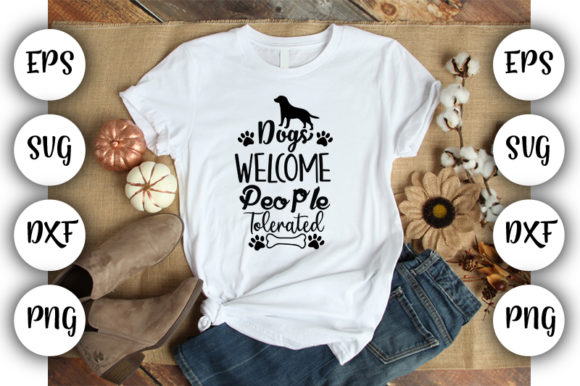
Dog Design: Dogs Welcome, People Tolerated
As a designer who’s stitched hundreds of custom pieces—from boutique aprons to Etsy-bestselling baby onesies—I opened Dog Design: Dogs Welcome, People Tolerated expecting playful irony. What I got was something sharper: a compact, confident graphic with real embroidery potential—if you know how to use it.
First Impressions: Witty, Not Cutesy
This isn’t a cartoon puppy wearing sunglasses. It’s clean-lined, slightly retro in proportion, and built for legibility—not just at 4 inches wide on a tote bag, but at 2.5 inches on a child’s sweatshirt cuff. The phrase “Dogs Welcome, People Tolerated” sits beneath a stylized dog silhouette (think mid-century illustration meets modern vector clarity). No gradients, no drop shadows—just bold negative space and intentional weight distribution. That matters. A lot.
I immediately pictured it on a natural linen tea towel for a local pet-friendly café—embroidered in charcoal grey thread, the dog’s ear just grazing the top hem. Or on a navy unisex sweatshirt for a rescue fundraiser, where the dry humor lands without alienating donors. This design doesn’t beg for attention; it earns it through restraint.
Where It Shines in Real Embroidery Projects
- Tote bags & aprons: The balanced width-to-height ratio prevents distortion on curved seams. I tested a 3.75" version on medium-weight canvas—no puckering, even across the strap attachment point.
- Sweatshirts & hoodies: Works best centered on the chest or upper back. The lettering has generous x-height and open counters—critical when stitch density compresses fine details on fleece-backed fabric.
- Embroidered patches: The solid dog shape holds up beautifully in satin stitch, and the text clears cleanly in running-stitch outlines. No tiny serifs or fragile connectors to fray after washing.
- Baby items & nursery decor: Surprisingly gentle tone—especially in soft peach or sage thread on organic cotton. Not saccharine, not sarcastic. Just quietly dog-obsessed.
- Holiday gifts & small shop merchandise: Stitches quickly (low to moderate stitch count, based on visual density), making it viable for batch production without sacrificing charm.
Where to Proceed With Care
This isn’t a one-size-fits-all embroidery file. Its personality is strong—and that means context is everything.
Avoid cramming Dog Design: Dogs Welcome, People Tolerated into sub-2" hoops. The lowercase “a” and “e” in “Tolerated” lose definition below 2.25". On stretchy knits like jersey tees? Use cutaway stabilizer *and* baste the fabric taut—those crisp corners won’t forgive waviness. Dark fabrics demand high-contrast thread (navy + bright white, charcoal + lemon yellow)—test first. And skip it entirely for curved surfaces like structured caps unless you’re using a cap frame and have confirmed the design fits within the front panel’s flat stitching zone.
The dog’s tail curls tightly. In dense fill stitch, that loop can trap thread or create stiffness. For baby clothes or pillow covers where softness is non-negotiable, consider simplifying that curve manually—or switching to a lighter fill density. Also: while the PNG and SVG files are great for digital mockups, remember—SVG isn’t embroidery-ready. You’ll need to digitize or convert properly for machine embroidery use. DXF and EPS help with scaling precision; PNG is strictly for previews.
How It Shapes Perception—Before and After Stitching
Customers don’t buy fonts or vectors. They buy feeling. This design signals warmth with wit, confidence without arrogance. When stitched cleanly on a heavyweight cotton tote, it reads as handmade-but-polished—ideal for an Etsy seller positioning themselves between craft fair charm and boutique credibility.
But get the execution wrong—fuzzy lettering, uneven satin stitch on the dog’s outline, or poor thread/fabric contrast—and that same design suddenly feels cheap or indecisive. That gap between concept and finished product is where many craft businesses lose trust. So yes: test on scrap fabric first. Yes: check how it looks in black-and-white mockups (some buyers browse in grayscale). Yes: confirm your license allows commercial use if you’re selling embroidered goods—not just the digital file.
Designer Notes You’ll Actually Use
- Run a stitch-density check before hooping. If the dog’s body fills too densely for your fabric weight, reduce fill % by 5–10% in your embroidery software.
- For personalized gifts, pair it with a simple monogram or paw print—don’t stack text. Let the design breathe.
- On textured fabrics (like waffle-weave towels), increase underlay stitches slightly to lift the top layer.
- When prepping for commercial embroidery, verify the design fits standard hoop sizes (4x4", 5x7") without manual resizing—distortion kills readability.
- Use printable mockups with realistic fabric drape—not flat white backgrounds—to show customers how it lives on real garments.
- If offering this as a digital embroidery file in your shop, clarify which formats are machine-ready (DXF/EPS often require conversion) and which are for reference only (PNG/SVG).
Final Thought: A Design That Earns Its Place
Dog Design: Dogs Welcome, People Tolerated isn’t background noise. It’s a conversation starter—with just enough edge to feel human, just enough clarity to stitch reliably, and just enough versatility to move across categories: from a holiday embroidered blanket for a new dog parent to a staff apron for a vet clinic that actually gets the joke.
It works because it respects the craft. It doesn’t overpromise detail. It doesn’t ignore fabric behavior. And it never mistakes volume for value.
That’s rare. And worth stitching right.