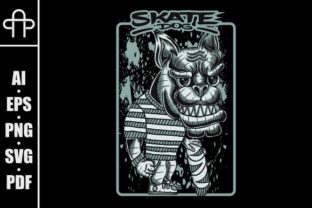
Skate Dog
A Designer’s First Look: Playful, Tight, and Ready for Stitching
When Skate Dog landed in my inbox, I paused mid-coffee sip—not because it’s flashy or overdesigned, but because it *feels* intentional. It’s a compact, confident illustration: a stylized dog mid-skate, tail up, wheels blurred just enough to suggest motion without sacrificing clarity. The silhouette is clean, the curves are balanced, and there’s no visual clutter—no tiny accessories, no background elements, no unnecessary gradients. That’s gold for embroidery designers. This isn’t just a graphic; it’s a design that *wants* to be stitched. It reads instantly at 3" wide on a tote bag, holds its charm at 1.75" on a baby onesie collar, and doesn’t beg for embellishment.
Where Skate Dog Shines in Real Projects
I tested Skate Dog across three real-life scenarios this week: a custom embroidered canvas tote for a local coffee shop’s staff gift, a set of organic cotton baby bodysuits for a boutique launch, and a limited-run patch collection for a skate-inspired apparel brand. In each case, Skate Dog elevated the finished product—not by shouting, but by landing with warmth and wit.
- Tote bags & aprons: Its bold outline and open negative space mean low stitch density and fast sew-outs—even on textured canvas or linen blends. No puckering, no thread breaks.
- Baby items & nursery decor: The rounded forms and friendly expression read as gentle, not edgy. On soft knit onesies or muslin pillow covers, it avoids looking “too cool” or overly graphic—just sweet, spirited, and handmade.
- Patches & sweatshirt embroidery: As an applique design or satin-stitched emblem, Skate Dog holds crisp edges. The wheel arcs and ear contours translate cleanly into satin stitch borders, and the fill areas (like the dog’s body) stay breathable—no dense fill stitch that stiffens fabric.
Where to Pause—and Plan Ahead
Skate Dog is versatile, but not magic. A few real-world considerations keep it from slipping into every project:
- Hoop size & detail fidelity: The wheels’ thin spokes and the subtle curve of the tail tip demand attention. Below 2.5", those details risk becoming indistinct—especially on stretchy knits or terry cloth. Always test on scrap first, especially if stitching on curved surfaces like caps or sleeves.
- Fabric texture vs. clarity: On heavy twill or looped terry, fine lines can disappear. For kitchen towels or blankets, consider simplifying the wheel detail manually—or lean into its strength as a bold, graphic statement instead of chasing precision.
- Dark fabric contrast: The original file includes vector formats (AI, EPS, SVG), which is ideal—you can easily adjust stroke weight or add a subtle drop shadow in your digitizing software. But don’t assume the default PNG will pop on navy or charcoal without tweaking thread colors or adding underlay.
- Wash durability: Because Skate Dog relies on shape and rhythm more than ultra-fine linework, it holds up well after repeated laundering—provided you use quality stabilizer and appropriate thread tension. That matters for baby clothes, tea towels, and personalized gifts meant to last.
What It Adds to Your Craft Business—Beyond the Stitch
As an Etsy seller and small shop owner myself, I judge designs not just by how they sew—but by how they make customers *feel*. Skate Dog lands as approachable, joyful, and authentically handmade—not mass-produced or clip-art-ish. That perception lifts perceived value: buyers pay more for a custom-embroidered sweatshirt with Skate Dog than one with a generic paw print. It also builds brand consistency. When used across a line—say, matching patches, tote bags, and baby bibs—it creates cohesion without repetition. And for holiday or wedding gifts? It’s unexpectedly charming: imagine Skate Dog on a linen kitchen towel beside a handwritten recipe card, or on a mini backpack for a toddler’s first day of preschool. It’s not trying to be everything—it’s confidently *one thing*, done well.
Practical Notes Every Embroidery Designer Should Run Through
Before sending Skate Dog to your machine—or listing it in your digital shop—here’s what I do, every time:
- Test on scrap fabric that matches your final project’s weight and stretch.
- Check thread color contrast on both light and dark backgrounds using a simple black-and-white mockup—this reveals clarity issues faster than color ever will.
- Review stitch density in your embroidery software: look for tight clusters near the wheels or snout that could cause buildup or stiffness.
- Confirm hoop compatibility: Skate Dog fits comfortably in a 4"x4" hoop at standard sizes—but verify before scaling beyond 3.5".
- Inspect corners and curves for potential jump stitches or awkward travel paths—especially important for commercial embroidery where speed and thread changes matter.
- Use cutaway or tear-away stabilizer appropriately—lightweight for knits, medium-weight for canvas, and always test on textured fabrics.
- Verify licensing terms before selling finished embroidered items or reselling Skate Dog as part of a digital bundle. Since it’s categorized under Illustrations and Graphics, confirm whether commercial use is included.
Final Thought: A Design That Serves the Maker
Skate Dog isn’t the flashiest file in your library—but it might become the most reliable. It respects the limits of thread and fabric while delivering personality and polish. It works for the hobbyist embroidering their first baby onesie, the Etsy seller building a cohesive product line, and the small shop owner sourcing unique design assets for boutique merchandise. It’s proof that strong illustration fundamentals—rhythm, balance, restraint—translate directly into strong embroidery results. If you’re choosing a machine embroidery design that needs to perform, resonate, and scale across real projects, Skate Dog earns its place in the working folder—not the inspiration board.